



Jokowi Era Sees More Indonesians Go Cashless

Jakarta. Indonesia has witnessed many major changes over the past 10 years of the outgoing leader Joko “Jokowi” Widodo, but one of the most noticeable changes is how the population has increasingly gone cashless.
Indonesia has the so-called Quick Response Code Indonesian Standard (QRIS) which lets people simply scan a QR barcode to make their purchase. QRIS -- pronounced as “kris” -- has become commonplace in Indonesia compared to its launch in August 2019, and is not only limited to the large stores. Even the small street vendors in Indonesia already have slapped QRIS barcode stickers on their carts.
The Covid-19 pandemic has forced many shops to only accept digital payments. Although the government already lifted the restrictions a long time ago, many shops have already gotten used to only accepting cashless payments. The growing cashless trend should also be no surprise as Indonesia's internet users have more than doubled compared to when Jokowi first became president in 2014.
Bank Indonesia, the country’s central bank, recently reported that QRIS users across the archipelago had totaled 53.3 million people as of the third quarter of 2024. About 34.23 million merchants are also accepting QRIS payments. QIRS transactions have also soared by up to 209.61 percent year-on-year, reaching Rp 188.36 trillion (nearly $12.2 billion) in Q3-2024. Many of these merchants are also small-scale sellers, particularly those selling food and beverages.
“Over the past 5 years, we have been witnessing a swift digital transformation. Digital payments and finances have saved the national economy from the effects of the Covid-19 pandemic,” Bank Indonesia’s governor Perry Warjiyo said, not long ago.
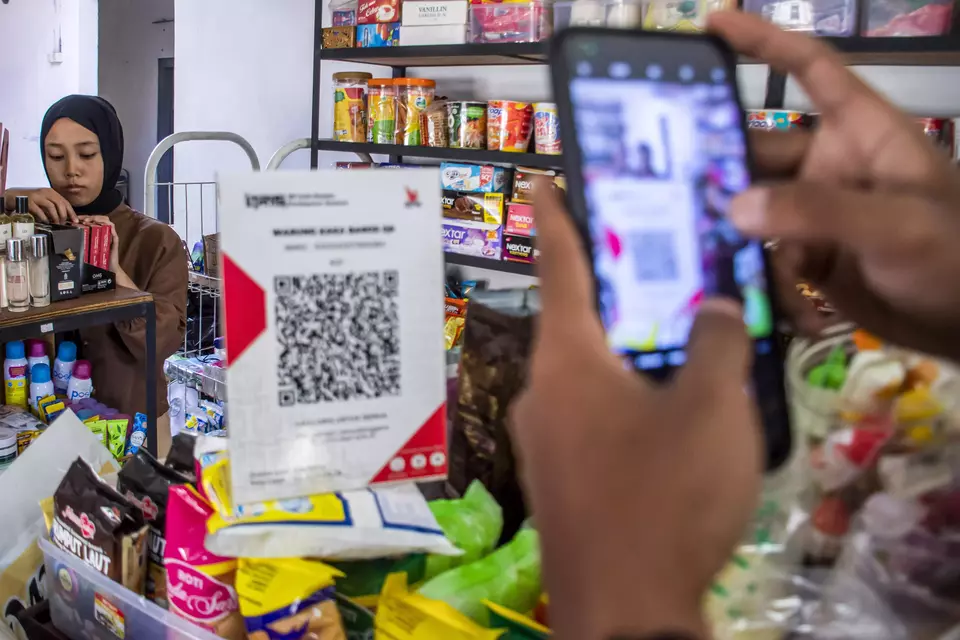
In the past, Jokowi had said that he wanted to see Indonesian micro, small and medium enterprises (MSMEs) not get left out in the cashless boom. MSMEs contribute approximately 61 percent of the country’s gross domestic product (GDP). This is equivalent to around Rp 9,580 trillion. Jokowi also wishes for these MSMEs to take advantage of Indonesia's QR code payments with other countries. For reference, Indonesia's QRIS is now connected to some of its ASEAN counterparts, including Thailand and Malaysia. In other words, Thai and Malaysian travelers can pay in their respective currencies by scanning the available QR codes in their mobile phones. The same goes for the Indonesian tourists when traveling to the said two countries.
“I’m pushing for this QR payment linkage. This will make it easier for our MSMEs and tourism sectors when interacting with international tourists,” Jokowi said, when launching the cross-border QR payment systems in Jakarta back in 2022.
Tags: Keywords: as a preferred
Related Articles

INDEF: Only 5% of Formal MSMEs Join Free Meals Program, Most See No New Business
Only 5% of formal MSMEs have ties to Indonesia’s free meals program, with most businesses yet to see new opportunities, INDEF says.
Indonesia’s Halal Certification Rules Face Calls for Overhaul
Indonesia’s halal certification deadline sparks calls to ease MSME burdens and adopt risk-based enforcement.
Indonesia, Hong Kong Move to Connect QR Payment Systems
Indonesia and Hong Kong are exploring a link between their QR payment systems to facilitate faster and easier cross-border transactions.
Indonesia Wants to Link QR Payment with Timor-Leste
In ASEAN, Indonesia's QRIS payment system is already available in Singapore, Thailand, and Malaysia.
Businesses Back Mandatory Halal Rules, Warn of Rising Compliance Costs
Businesses support Indonesia’s mandatory halal rules but urge simpler certification and lower compliance costs to protect MSMEs and consumer
Bank Indonesia Says Digital Money Won’t Replace Cash
Bank Indonesia says digital payments will complement rather than replace cash as Indonesia accelerates its shift to digital transactions.
Indonesia's QRIS Digital Payments Surge 100% in H1 2026
Indonesia's QRIS payment transactions doubled to 12.55 billion in H1 2026, with transaction value reaching Rp600.69 trillion.
Indonesia Targets India, Saudi Arabia and Hong Kong for Cross-Border QRIS Expansion
Bank Indonesia plans to expand cross-border QRIS to India, Saudi Arabia and Hong Kong as digital payments surge.
Indonesia, India to Connect QR Payment Systems by End-2026
Indian Prime Minister Narendra Modi says that a cross-border QR payment linkage with Indonesia will improve ease of doing business.
Indonesia Vows to Empower Small Businesses
The government has rolled out programs to help provide ease of doing business and access to financing.The Latest

Ye Concert, Other Events to Draw 130,000 to GBK, Here’s What to Know
Around 130,000 visitors are expected at Jakarta’s GBK on Saturday as Ye’s concert and several major events take place.
Indonesia Allocates Rp 722 Billion for Year-End Flight Ticket Tax Relief
Indonesia allocates Rp 722 billion to cover domestic flight ticket VAT during the 2026/2027 Christmas and New Year holidays.
Greece Floats Shipbuilding Partnership with Indonesia
Greece says that it possesses “extensive expertise” as it woos Indonesia in shipbuilding partnership.
Indonesian Stocks Rally 4.9%, but Foreign Investors Keep Selling
Indonesia’s JCI rose 4.9% last week, but foreign selling and MSCI downgrade risks continue to cloud the market outlook.
Ye Concert in Jakarta to Deploy 2,000 Security Personnel
More than 2,000 personnel will secure Ye’s Jakarta concert on Saturday, as organizers urge fans to use public transport.Most Popular
