



Java 7 Power Plant Marks 75 Years of Indonesia-China Relations with Clean Energy Commitment
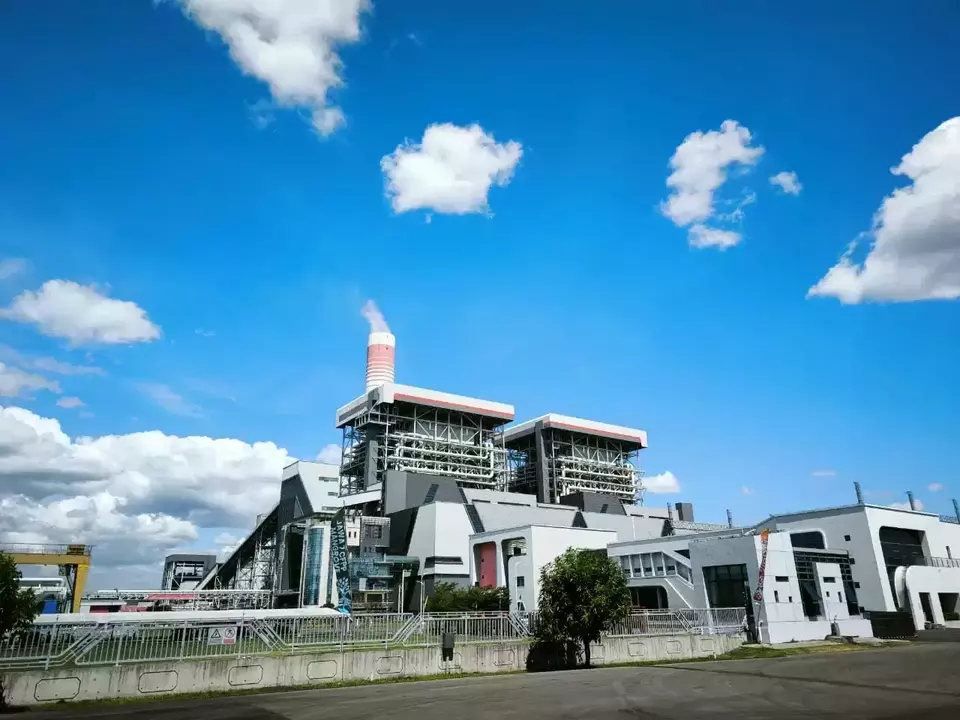
Serang, Banten. Indonesia and China commemorated 75 years of diplomatic ties on Sunday with a mangrove reforestation ceremony at the Java 7 power plant, a symbol of the two nations' partnership in energy and environmental cooperation. China also reaffirmed its commitment to Indonesia's clean energy transition through the development of a floating solar power plant in East Java.
Built through a joint venture between China Energy Investment Group and Indonesia’s PLN Nusantara Power, the Java 7 plant in Serang, Banten, reflects decades of bilateral collaboration. Operated by Shenhua Guohua Pembangkitan Jawa Bali (SGPJB), the ultra-supercritical coal-fired power station has generated more than 55.59 billion kWh since beginning operations in 2019, significantly contributing to the energy supply across Java and Bali.
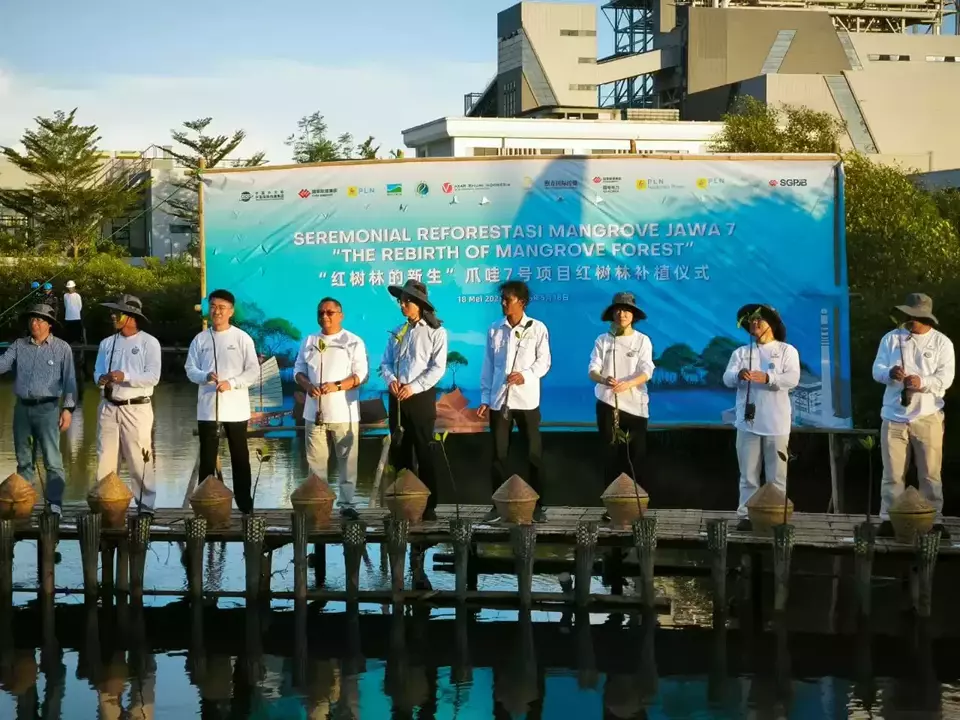
The ceremony, themed “The Rebirth of Mangrove Forest,” was jointly organized by CHN Energy Investment Group and China International Communications Group, with support from China’s Ministry of Ecology and Environment and GD Power Development Co., Ltd. GD Power and PLN are partnering on the East Java floating solar power project.
“The Java 7 power plant will continue to play an active role in mangrove conservation and is ready to collaborate with stakeholders from various sectors to realize sustainable green development,” said SGPJB President Director Zhao Zhigang in a statement.
Since its inception, the Java 7 plant has expanded its mangrove reforestation site from 5 hectares to nearly 19 hectares. The effort gained international recognition last year when the site was designated the world’s first International Mangrove Center during a convention in Shenzhen.
Doddy Nafiudin, Director of General Affairs at SGPJB, said the 75th anniversary of Indonesia-China diplomatic relations reflects more than just history; it signifies a robust, future-oriented collaboration. “Our partnership with China is a cornerstone in Indonesia’s push for energy security and sustainable infrastructure,” Doddy said. “China’s contributions extend beyond capital, encompassing cutting-edge technologies and long-term cooperation.”
The Java 7 plant employs ultra-supercritical (USC) clean coal technology, which reduces fuel consumption and emissions compared to conventional coal power. Despite relying on coal, the plant has implemented extensive environmental safeguards, including real-time emissions monitoring connected to Indonesia’s Environment Ministry, flue gas desulfurization units, low-NOx burners, and the repurposing of coal ash for use in construction materials. SGPJB has also initiated tree-planting programs, buffer zone greening, and community-based environmental education.
"We see this relationship as a foundation to strengthen cooperation in clean energy technology, efficiency improvements, and better emission management," he said.
Looking ahead, Doddy highlighted China’s continued investment in Indonesia’s clean energy goals, notably the Karangkates floating solar power plant in Malang, East Java. The 129 MWp solar project, a collaboration between GD Power and PLN’s renewable subsidiaries, is scheduled to begin operation in 2026 and is expected to supply 219 GWh of clean energy annually, cutting carbon emissions by up to 180,000 tons and providing a 75 percent renewable energy share by 2040.
“Clean energy is no longer a choice; it’s a necessity,” Doddy said. “The partnership between Indonesia and China offers a powerful platform to accelerate our transition to a more adaptive, reliable, and sustainable energy future.”
Tags: Keywords: as a preferred
The Latest

Prabowo Calls Meeting on Forest Fires as Haze Reaches Jakarta, Singapore
Prabowo summons senior officials to discuss forest fires as smoke reaches Jakarta and Malaysia pushes for regional action.
Jakarta Outranks Amsterdam in Global Public Transport Survey
Jakarta climbs two places to 15th in Time Out's 2026 public transport survey, with its governor citing better network integration.
MSCI Concerns, Tighter IDX Trading Rules Send Indonesian Stocks Down 5% by Midday
Indonesian stocks plunge 5% by midday as MSCI concerns weigh on sentiment and the IDX tightens its daily downside limit to 7%.
Jakarta Prepares 367 Health Facilities as Haze Reaches the Capital
Jakarta prepares 367 health facilities to treat potential haze-related illnesses after smoke from Sumatra and Kalimantan crosses the region.
Jakarta Expands Flood Prevention With New Water Storage Ponds
Jakarta opens two East Jakarta water storage ponds as it expands flood prevention efforts through reservoirs and river normalization.Most Popular
