



From BRICS to EU: A Thousand Friends Are Too Few in Trade

Jakarta. The maxim “A thousand friends are too few, one enemy is too many” has evolved into a strategic organizing principle for President Prabowo Subianto’s foreign economic diplomacy, shaping Indonesia’s pursuit of broad-based partnerships while minimizing geopolitical and commercial vulnerabilities.
Prabowo’s early major move as president was to have Indonesia apply to BRICS -- a bloc of emerging economies that includes Brazil, Russia, India, China, and South Africa. BRICS -- known to be a counterweight to Western influence -- accepted Indonesia in January, making Jakarta its first ASEAN member. Indonesia is now eyeing a seat at the New Development Bank, with Jakarta planning to invest $1 billion in the BRICS-backed lender.
But one cannot describe the year 2025 without mentioning tariffs. When US President Donald Trump launched his tariff assault in April, the world was left with two choices: to negotiate or retaliate. Jakarta chose the first option. Prabowo spoke with Trump over the phone -- a call that eventually led to Washington bringing down the tariffs from 32 percent to 19 percent. Negotiations for the final trade deal have been underway over the past months, with Jakarta planning to get tariff exemptions on its US-bound palm oil.
The tariffs -- coupled with Prabowo’s drive to befriend everyone -- motivated Indonesia to expand its export markets.
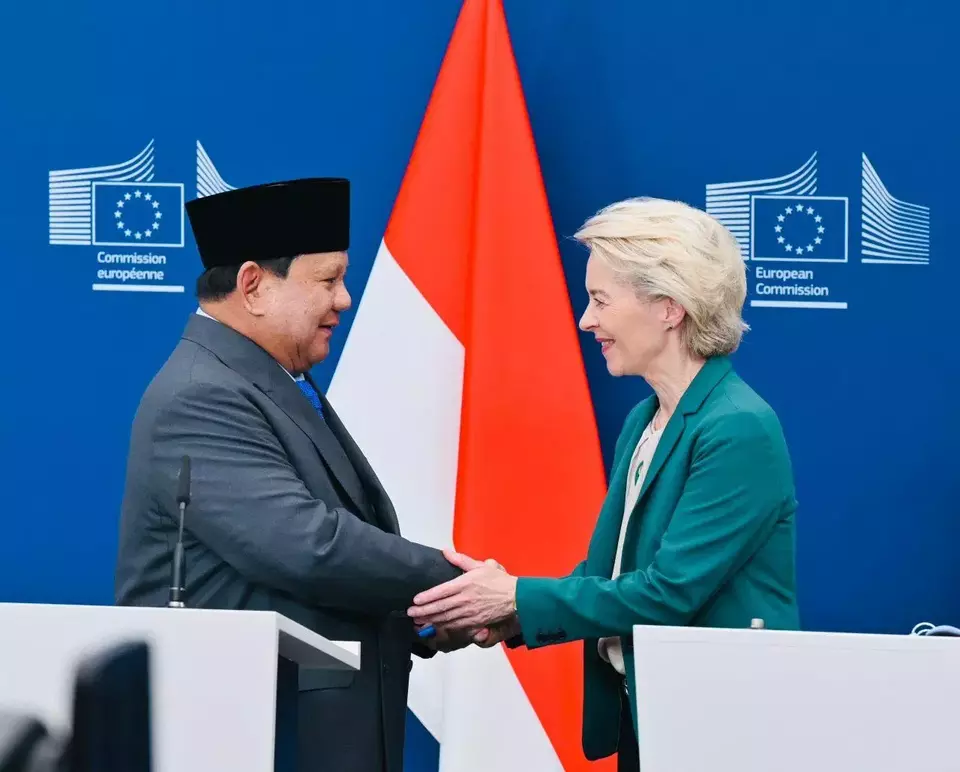
In September, Indonesia officially wrapped up the negotiations of its Comprehensive Economic Partnership Agreement (CEPA) with the European Union (EU) after almost a decade of talks. Prabowo even traveled to Brussels himself a month earlier to show that Jakarta really wanted to clinch the deal. The CEPA, which is to enter into force in early 2027, will slash virtually all tariffs on each other’s goods. Indonesia-EU trade hit $30.1 billion in 2024. Jakarta expects this accord to double the trade numbers within five years since its implementation.
Indonesia and Peru struck a CEPA in the same year, enabling Jakarta to tap into the Latin American market. Indonesia became the first ASEAN nation to strike a bilateral trade pact with Canada when Prabowo visited Ottawa in September. Jokowi had passed the baton to Prabowo to make Indonesia part of the rich country club OECD by 2027.
Anne Patricia, the head of trade affairs at the business group Apindo, had said that accelerating trade agreements -- both existing and those still seeking lawmakers’ approval -- remained key “to cement Indonesia’s position in the increasingly competitive global trade”.
Prabowo’s recent trip to Pakistan saw both countries agreeing to upgrade their trade agreement to eliminate more tariffs by 2027. This stems from Pakistani Prime Minister Shehbaz Sharif’s wish to rebalance the trade that was heavily tilted in Jakarta’s favor. Indonesia’s annual surplus with Islamabad reaches at least $3 billion as of October.
Former Deputy Foreign Minister Dino Patti Djalal described Prabowo -- a frequent overseas traveler -- as someone “hyperactive” in foreign policy. Dino said Prabowo had developed a “very good political and diplomatic capital” with his peers, such as Trump and China’s Xi Jinping.
International relations analyst Muhammad Habib agreed that Indonesia should diversify its exports to non-traditional markets.
“But going forward, it’d be better for Indonesia to conduct its economic diplomacy more systematically. This means that Indonesia should not only analyze the opportunities, but the risks that may arise from the diversification,” Habib told the Jakarta Globe.

 as a preferred
Related Articles

EU Tariff Deal to Make German Cars in Indonesia More Affordable
Senior minister Airlangga Hartarto says the upcoming trade deal will cut tariffs on European car imports to "close to 0%".
Indonesia to Upscale Rice and Maize Exports, Prabowo Tells BRICS
Prabowo tells BRICS that Indonesia has transformed into a rice exporter, and is willing to "increase the support for the entire world".
‘Currency Must Not Be Weaponized’, Prabowo Tells BRICS
Prabowo tells BRICS that "trade and currency must not be weaponized" as discussions to shift away from the dollar gain momentum.
BRICS Indirectly Hits Out at Trump’s Tariffs, WTO Paralysis
BRICS doesn't want to see unilateral tariffs and a paralyzed WTO court system, all of which are linked to the US.
Prabowo Lands in India for BRICS Talks, Local Currency on Agenda
Indonesia is the youngest member in BRICS, having only joined the group in early 2025.
Indonesia’s Sustainable Cocoa is Not Only for EU
The EU will soon only accept imported cocoa that is proven to not come from deforested land.
Indonesia Banks On EU as Trump's 10% Tariff Kicks In
Indonesia wants to fast-track its European Union (EU) trade deal as Jakarta tries to find alternatives to the tariff-agressive US.
Indonesia Secures Partial WTO Win Over EU Fatty Acid Duties
Indonesia wins a partial WTO ruling against EU anti-dumping duties on fatty acids, but most of its legal claims are rejected.
Germany Says Trade Still Unharmed by Indonesia’s One-Gate Export
Indonesia’s export system shake-up has no immediate impact on trade, palm oil importer Germany says.
Trump to Exempt Indonesian Palm Oil from Tariffs
Indonesia says rubber and coffee will also gain US tariff exemptions.The Latest

Prabowo Calls Meeting on Forest Fires as Haze Reaches Jakarta, Singapore
Prabowo summons senior officials to discuss forest fires as smoke reaches Jakarta and Malaysia pushes for regional action.
Jakarta Outranks Amsterdam in Global Public Transport Survey
Jakarta climbs two places to 15th in Time Out's 2026 public transport survey, with its governor citing better network integration.
MSCI Concerns, Tighter IDX Trading Rules Send Indonesian Stocks Down 5% by Midday
Indonesian stocks plunge 5% by midday as MSCI concerns weigh on sentiment and the IDX tightens its daily downside limit to 7%.
Jakarta Prepares 367 Health Facilities as Haze Reaches the Capital
Jakarta prepares 367 health facilities to treat potential haze-related illnesses after smoke from Sumatra and Kalimantan crosses the region.
Jakarta Expands Flood Prevention With New Water Storage Ponds
Jakarta opens two East Jakarta water storage ponds as it expands flood prevention efforts through reservoirs and river normalization.Most Popular
